
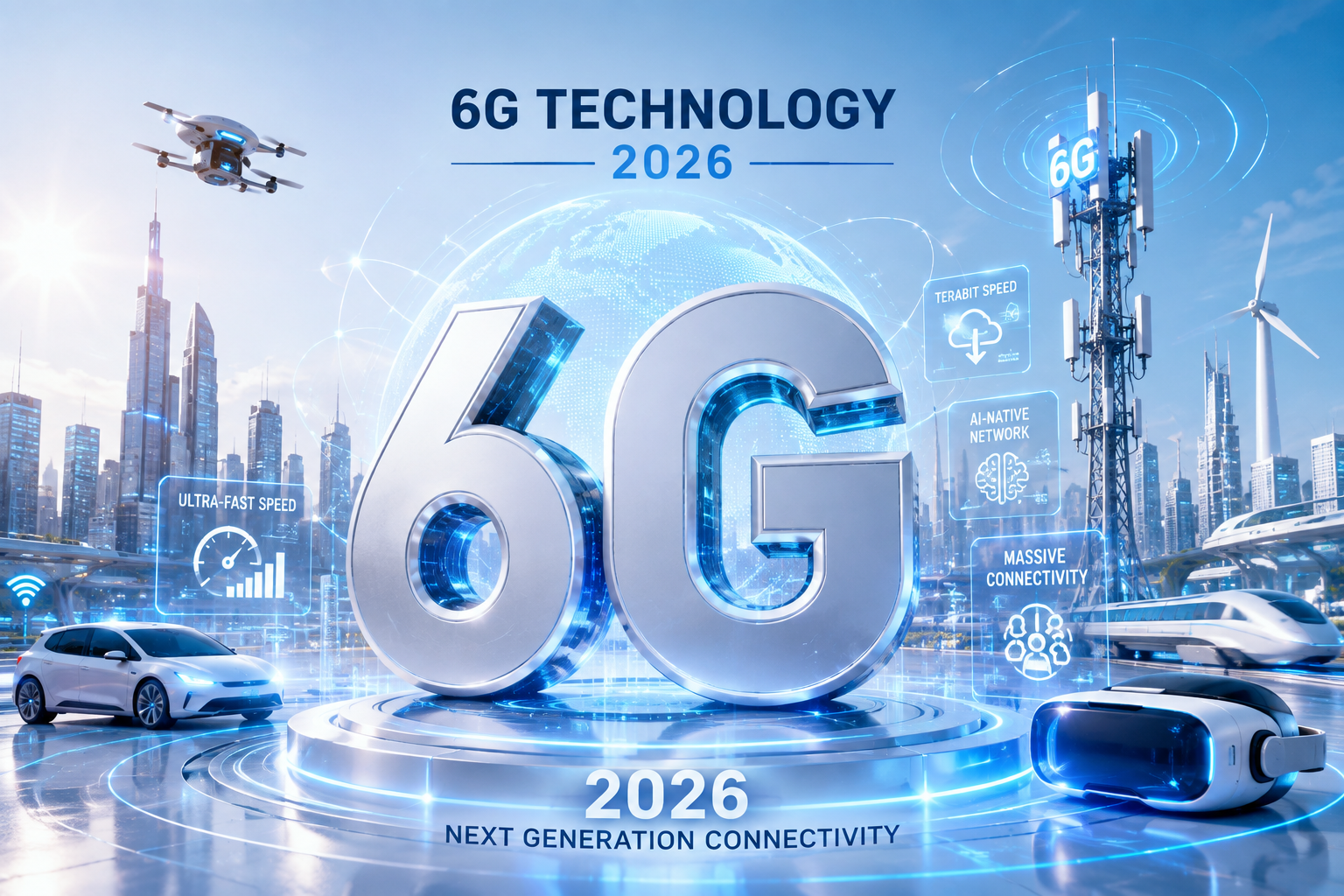
Although many regions are still expanding 5G infrastructure, researchers, network providers and technology companies are already making significant progress toward sixth-generation (6G) wireless networks.
6G aims to provide dramatically faster speeds, lower latency and greater network reliability than previous generations. These advancements will support applications that require near-instant communication and the seamless exchange of massive amounts of data.
Potential applications include:
-
Real-time holographic communication
-
Advanced autonomous transportation
-
Industrial automation
-
Smart manufacturing
-
Immersive virtual collaboration
-
Remote robotic surgery
-
Large-scale Internet of Things (IoT) ecosystems
Unlike earlier mobile technologies, 6G is expected to integrate artificial intelligence directly into network management, enabling smarter traffic optimization, predictive maintenance and improved energy efficiency.
For businesses, this means more reliable cloud services, enhanced remote collaboration and support for data-intensive applications. Consumers can expect faster downloads, higher-quality streaming and richer digital experiences.
Why 6G Matters
-
Ultra-low latency
-
Higher network capacity
-
AI-driven network optimization
-
Enhanced IoT performance
-
Improved digital experiences
-
Smarter cities and infrastructure
Benefits of 6G Technology
The development of 6G could create significant benefits for businesses, governments, industries and consumers as connectivity becomes increasingly important to digital transformation.
1. Faster and More Reliable Connectivity
6G is expected to deliver substantially higher data speeds and improved network reliability. This could make it easier to transfer large files, operate cloud applications, stream high-quality content and connect advanced digital services.
2. Ultra-Low Latency
Reduced communication delays could enable applications that depend on almost instantaneous responses. Autonomous vehicles, industrial robots, remote control systems and immersive digital environments could benefit from faster communication between devices and networks.
3. Smarter Artificial Intelligence Networks
AI could become an integral part of 6G network operations. Intelligent systems could automatically identify congestion, optimize network resources, detect potential failures and adjust performance according to changing demand.
4. Advanced IoT Connectivity
As billions of connected devices continue to emerge, future networks will need to efficiently manage huge numbers of sensors, machines, vehicles and smart devices. 6G could provide the capacity and intelligence required to support these large-scale IoT ecosystems.
5. Improved Industrial Automation
Manufacturing facilities could use 6G to connect robots, sensors, digital twins, and automated control systems with minimal communication delays. This could improve production efficiency, monitoring, maintenance and workplace safety.
6. Enhanced Immersive Experiences
Virtual reality, augmented reality, mixed reality and other immersive technologies require fast and reliable networks. 6G could help deliver more responsive virtual environments and support new forms of digital collaboration, entertainment, education and communication.
7. Smarter Cities and Infrastructure
Future smart cities could use advanced connectivity to coordinate traffic systems, public transportation, energy networks, security infrastructure, environmental sensors, and other connected services in real time.
What is 6G?
6G is the proposed sixth generation of wireless communication technology. It is being developed to provide faster connectivity, lower latency, greater network capacity, improved intelligence, and support for advanced applications beyond the capabilities of current 5G networks.
Is 6G available in 2026?
6G is not yet available as a widespread commercial mobile network in 2026. Research, technology demonstrations, trials, and standardization activities are continuing as the industry works toward defining and developing the next generation of wireless connectivity.
How fast will 6G be?
The final performance specifications of 6G have not been established. However, researchers envision significantly higher data rates than today’s mobile networks, alongside extremely low latency and improved capacity.
Will 6G replace 5G?
Eventually, 6G is expected to become the next generation of mobile connectivity, but it is unlikely to immediately replace 5G. Existing 5G networks will continue to expand and operate while 6G technologies are developed, standardized, tested, and gradually introduced.
What will 6G be used for?
Potential applications include autonomous transportation, smart manufacturing, advanced robotics, immersive virtual and augmented reality, massive IoT networks, smart cities, real-time digital twins, advanced healthcare technologies, and high-speed communication services.
Will 6G require new devices?
Yes. When commercial 6G networks eventually become available, users will likely need compatible smartphones, routers, sensors, industrial equipment and other devices to take full advantage of the new technology.
How will AI be used in 6G?
AI could be used to automatically optimize network traffic, manage resources, predict equipment failures, improve energy efficiency, detect unusual network behavior and dynamically adapt network performance to changing conditions.
The Future of Connectivity
The transition toward 6G represents more than simply increasing mobile internet speeds. It could fundamentally change how people, machines, vehicles, businesses, and infrastructure communicate.
Conclusion
6G is emerging as one of the most important long-term developments in wireless connectivity. While commercial deployment remains in the future, ongoing research, trials, and standardization efforts are laying the foundation for a new generation of intelligent and highly connected networks. |<< Previous Part Sustainable Green Technology… | AI-Powered Cybersecurity… Next Part >>|
About the Author
Olu-Tope Abraham is an IT Support Specialist, Web Developer, Full-Stack Developer, and Digital Technology Professional with experience in technology, web development, IT support, and digital innovation. He is passionate about emerging technologies, artificial intelligence, cybersecurity, software development, and helping readers understand how technology is transforming businesses and everyday life.
Through Toplinks Techs, he shares practical technology guides, industry insights, emerging tech trends, tutorials and informative content designed to help readers stay informed in the rapidly evolving digital world.
Toplinks Techs — Innovate. Explore. Elevate. Tech That Inspires Progress.