
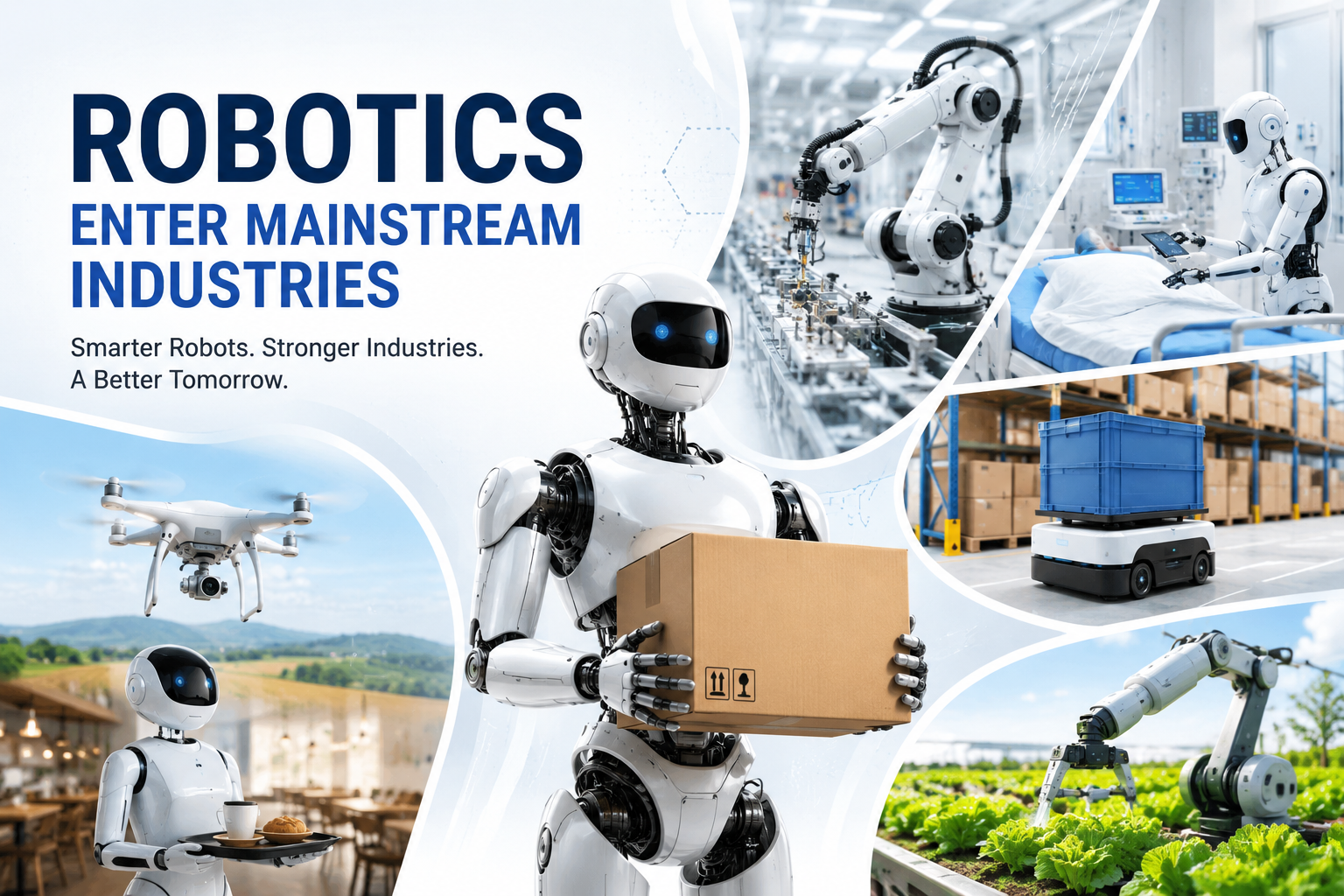
Robotics is no longer limited to automotive manufacturing. In 2026, robots are expected to become increasingly common across healthcare, agriculture, logistics, retail, contruction, hopitality and even households.
Collaborative robots, often referred to as cobots, are designed to work safely alongside humans. They assist with repetitive, physically demanding, or precision-based tasks, improving efficiency while reducing workplace injuries.
In healthcare, robotic systems support surgeons with minimally invasive procedures, assist in rehabilitation and help automate hospital logistics. In agriculture, autonomous machines are used for planting, harvesting,and crop monitoring, helping farmers improve yields while conserving resources and lots more.
Benefits of Robotics
Higher operational efficiency: Robots can perform repetitive tasks consistently and operate for extended periods, helping businesses increase productivity.
Reduced human error: Automated systems can perform highly repetitive and precision-based operations with greater consistency.
Increased workplace safety: Robots can handle hazardous, heavy, or physically demanding tasks, reducing workers’ exposure to dangerous environments.
Faster manufacturing and production: Automated machinery can accelerate production processes while maintaining consistent quality.
Improved healthcare services: Medical robots can assist healthcare professionals with surgery, rehabilitation, transportation, and other specialized tasks.
Better resource management: Agricultural and industrial robots can use data and sensors to optimize water, materials, energy, and other resources.
Support for labor shortages: Automation can help organizations manage repetitive workloads when it is difficult to find enough workers.
Greater business scalability: Companies can gradually introduce robotic systems as their operations grow instead of relying entirely on manual processes.
Challenges of Robotics Adoption
Despite its benefits, robotics also presents challenges. The initial cost of purchasing and deploying robotic systems can be significant, particularly for small businesses. Organizations may also need employees with specialized skills to operate, maintain, and program robotic equipment.
The Future of Robotics in 2026 and Beyond
The next phase of robotics will likely focus on greater autonomy, improved artificial intelligence, better sensors, and closer collaboration between humans and machines.
AI-powered robots are becoming increasingly capable of understanding their surroundings, responding to changing conditions, and completing more complex tasks.
FAQs About Robotics
1. What industries are adopting robotics in 2026?
Robotics is expanding across manufacturing, healthcare, agriculture, logistics, retail, construction, hospitality, transportation, and domestic applications.
2. What are collaborative robots or cobots?
Cobots are robots designed to work alongside human employees. They are commonly used for repetitive, physically demanding, or precision-based tasks.
3. Will robots replace human workers?
Robots may automate some tasks and change certain jobs, but they can also create new roles involving programming, maintenance, supervision, engineering, and system management. In many workplaces, robots are intended to complement rather than completely replace human workers.
4. How are robots used in healthcare?
Robotic systems can assist surgeons, support physical rehabilitation, transport supplies, automate certain hospital processes, and improve precision in specialized procedures.
5. Why is robotics important for businesses?
Robotics can improve productivity, consistency, workplace safety, and operational efficiency while helping businesses manage repetitive workloads and labor shortages.
Conclusion
Robotics is moving from specialized industrial environments into a much broader range of industries and everyday applications. In 2026, businesses are increasingly using robots to improve efficiency, enhance safety, automate repetitive processes, and address operational challenges.
The combination of robotics and artificial intelligence is particularly important because it is enabling machines to perform increasingly sophisticated tasks. << Previous Part 6G Network Generation | Artificial Intelligent Agents Next Part >>
About the Author
Olu-Tope Abraham is an IT Support Specialist, Web Developer, Full Stack Developer, and technology enthusiast with practical experience in web development, IT infrastructure, digital solutions, and technology-focused content creation.
As the creator behind Toplinks Techs, Olu-Tope focuses on making technology easier to understand and more accessible to everyday users, professionals, entrepreneurs, students and technology enthusiasts.
Toplinks Techs — Innovate. Explore. Elevate. Tech That Inspires Progress.