
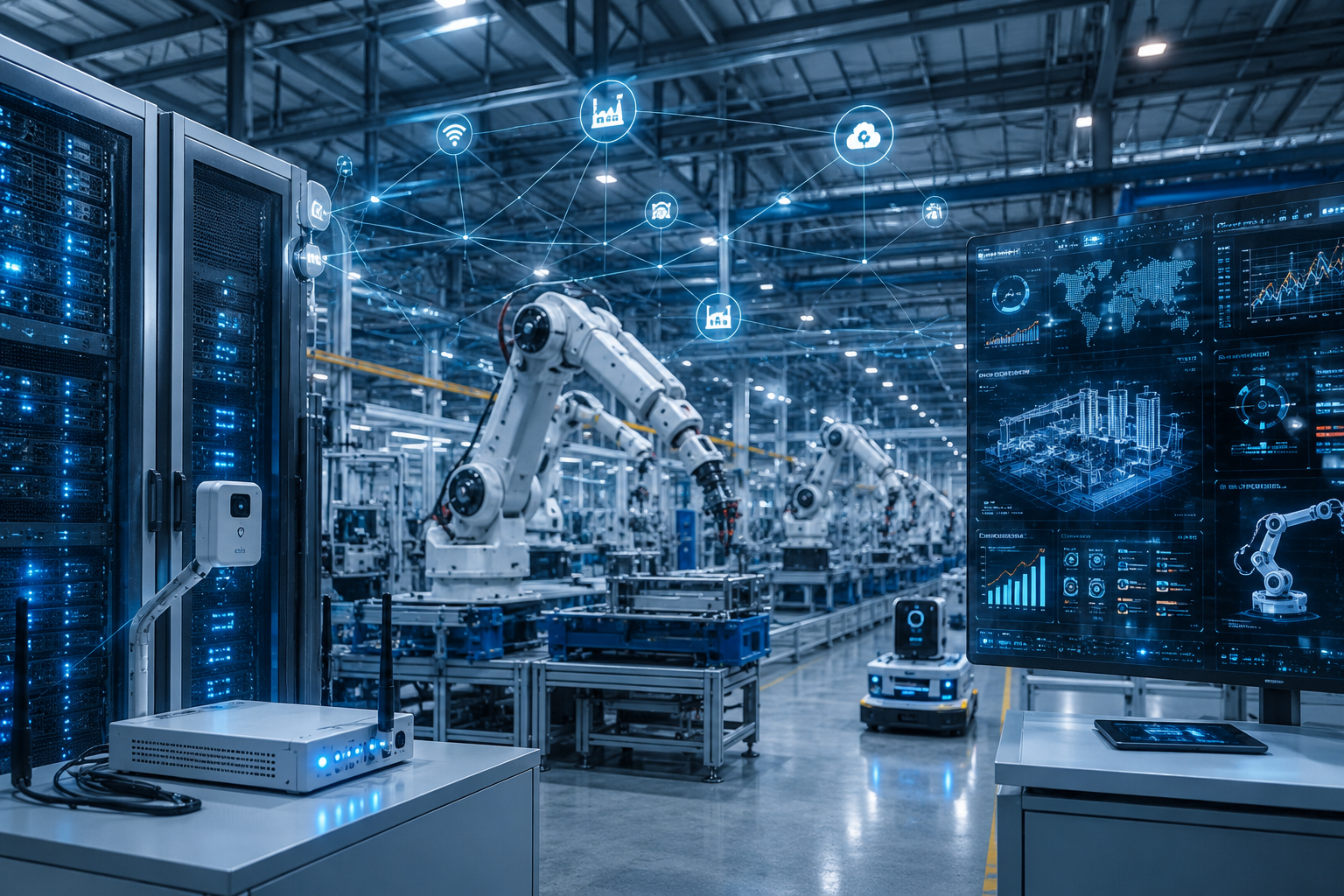
As billions of connected devices generate increasing amounts of data, processing information closer to where it is created has become increasingly important.
Edge computing addresses this challenge by moving computing resources nearer to users and devices rather than relying entirely on centralized cloud servers.
Instead of sending every piece of information to a distant data center, edge devices process critical data locally, resulting in faster response times, reduced bandwidth usage, and improved reliability.
Industries benefiting from edge computing include:
Healthcare
Medical devices can process patient data in real time, enabling faster diagnoses and emergency responses.
Manufacturing
Factories use edge computing to monitor equipment, detect faults, and automate production with minimal delays.
Transportation
Autonomous vehicles rely on rapid decision-making that requires processing data almost instantly.
Smart Cities
Traffic management systems, surveillance cameras, environmental sensors, and public infrastructure use edge computing to improve urban services.
Retail
Retailers analyze customer behavior and inventory in real time, improving operational efficiency and customer experiences.
Edge computing also enhances privacy by allowing sensitive information to remain closer to its source rather than transmitting everything to cloud servers.
Advantages
Enhanced IoT performance
Lower latency
Improved security
Faster analytics
Reduced bandwidth costs
Better reliability
Benefits of Edge Computing Across Industries
Edge computing offers significant advantages for organizations that depend on real-time data processing and connected devices. As digital transformation accelerates, businesses can leverage edge computing to improve efficiency, security, and overall performance.
1. Faster Decision-Making
By processing data close to its source, edge computing significantly reduces delays, enabling systems to respond almost instantly. This is especially critical for healthcare, industrial automation, autonomous vehicles, and emergency services.
2. Reduced Network Congestion
Instead of transmitting massive amounts of raw data to cloud servers, only relevant information is sent, reducing internet bandwidth consumption and lowering operational costs.
3. Improved Data Privacy
Sensitive information can remain within local devices or private edge servers, reducing exposure to cyber threats and helping organizations comply with data privacy regulations.
4. Higher Reliability
Edge devices can continue operating even when internet connectivity is slow or temporarily unavailable, ensuring uninterrupted business operations.
5. Better Performance for IoT Devices
Internet of Things (IoT) devices generate enormous volumes of data every second. Edge computing processes this data efficiently, enabling smart devices to operate more accurately and with lower latency.
6. Cost Savings
Organizations reduce cloud storage, data transfer, and bandwidth expenses by processing information locally before sending only essential data to centralized systems.
7. Scalable Infrastructure
Businesses can gradually expand their edge infrastructure as more connected devices are deployed without overwhelming centralized cloud resources.
(FAQs)
What is edge computing?
Edge computing is a distributed computing model that processes data near the device or location where it is generated instead of sending all data to a centralized cloud or data center.
How is edge computing different from cloud computing?
Cloud computing processes information in centralized data centers, while edge computing performs processing closer to users or devices. Both technologies often work together, with edge handling time-sensitive tasks and the cloud managing large-scale storage and analytics.
Why is edge computing important?
It reduces latency, improves reliability, enhances security, lowers bandwidth usage, and enables real-time processing for applications that require immediate responses.
Which industries benefit the most from edge computing?
Industries experiencing the greatest benefits include:
-
- Healthcare
-
- Manufacturing
-
- Transportation
-
- Smart Cities
-
- Retail
-
- Energy and Utilities
-
- Agriculture
-
- Telecommunications
-
- Financial Services
-
- Logistics
Does edge computing replace cloud computing?
No. Edge computing complements cloud computing rather than replacing it. Most modern organizations use a hybrid approach where edge devices process critical data locally while cloud platforms provide long-term storage, machine learning, and large-scale analytics.
Is edge computing secure?
Edge computing can improve security by keeping sensitive information closer to its source and reducing unnecessary data transmission. However, organizations must still implement encryption, authentication, regular software updates, and endpoint security to protect edge devices.
What role does AI play in edge computing?
Artificial Intelligence enables edge devices to analyze data locally, recognize patterns, automate decisions, and perform predictive analytics without relying entirely on cloud-based processing.
Conclusion
Edge computing is becoming a foundational technology for the next generation of digital services. By bringing computing power closer to where data is generated, organizations can achieve faster response times, improved reliability, enhanced security, and more efficient use of network resources.
As technologies such as Artificial Intelligence, 5G, autonomous transportation, smart healthcare, and the Internet of Things continue to evolve, edge computing will play an increasingly important role in delivering real-time intelligence and seamless digital experiences. |<<Previous Part 6G and Next-Gen Technology… Extended Reality (XR)… Next Part>>|
About Author
Olu-Tope Abraham is an IT Support Specialist, Web Developer and technology content creator with a passion for making emerging technologies understandable and accessible. As the founder of Toplinks Techs, he publishes well-researched articles covering artificial intelligence, cybersecurity, consumer technology, software development, cloud computing, digital transformation and future technology trends. His goal is to help individuals and businesses stay informed about the innovations shaping the digital world while providing practical insights they can apply in everyday life.
ToplinksTechs – Innovate. Explore. Elevate. Tech That Inspires Progress.