
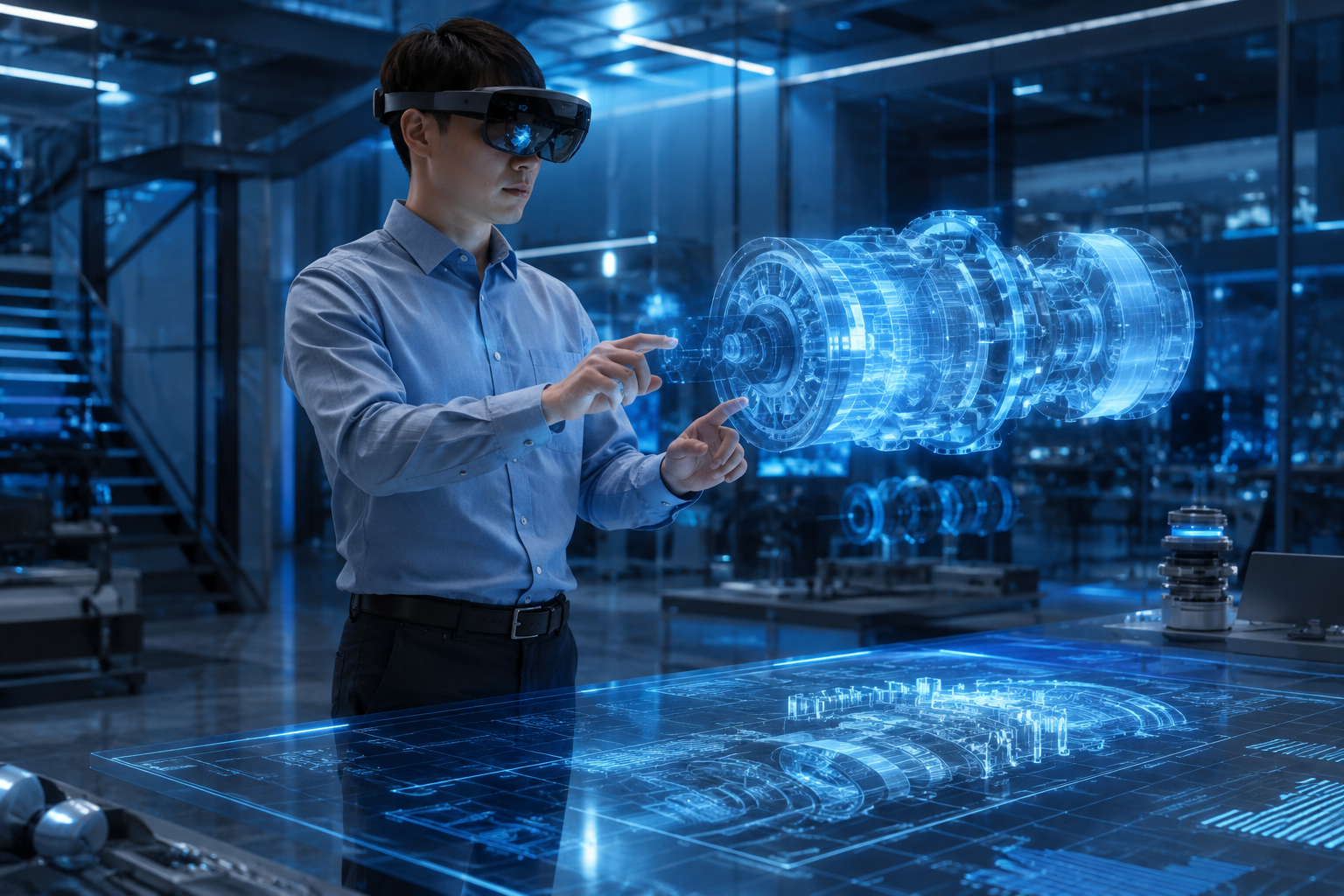
Extended Reality (XR), an umbrella term that includes Virtual Reality (VR), Augmented Reality (AR), and Mixed Reality (MR), is evolving beyond gaming and entertainment.
In 2026, XR technologies are becoming practical tools for education, healthcare, engineering, retail, manufacturing, and remote collaboration.
Educational institutions are using immersive simulations to teach complex subjects, allowing students to interact with realistic virtual environments. Healthcare professionals use XR for surgical training, patient rehabilitation, and medical visualization.
Businesses are increasingly adopting virtual workspaces where distributed teams can collaborate using immersive digital environments, reducing travel costs while enhancing communication.
Retailers are improving online shopping experiences by enabling customers to visualize furniture, clothing, and home décor before making purchases.
Construction and architecture firms use XR to review building designs, identify potential issues, and improve project planning before construction begins.
Real-World Applications
-
- Employee training
-
- Medical education
-
- Product design
-
- Virtual tourism
-
- Remote collaboration
-
- Retail visualization
-
- Engineering simulations
Benefits
-
- Improved learning experiences
-
- Better collaboration
-
- Reduced project costs
-
- Enhanced customer engagement
-
- Faster product development
(FAQs)
1. What is Extended Reality (XR)?
Extended Reality (XR) is a collective term that includes Virtual Reality (VR), Augmented Reality (AR), and Mixed Reality (MR). These technologies blend the physical and digital worlds to create immersive experiences for users across various industries.
2. How is XR different from Virtual Reality (VR)?
Virtual Reality (VR) completely immerses users in a computer-generated environment using a headset. XR is a broader category that also includes Augmented Reality (AR), which overlays digital content onto the real world, and Mixed Reality (MR), which allows digital and physical objects to interact in real time.
3. Which industries benefit the most from XR?
XR is transforming numerous sectors, including:
-
- Healthcare
-
- Education
-
- Manufacturing
-
- Retail
-
- Architecture and Construction
-
- Engineering
-
- Automotive
-
- Real Estate
-
- Tourism
-
- Entertainment
Each industry uses XR differently, from employee training and product design to customer engagement and remote collaboration.
4. How does XR improve education?
XR enables students to experience interactive simulations, virtual laboratories, historical recreations, and practical training that would otherwise be expensive or impossible to conduct in traditional classrooms. This improves understanding, engagement, and knowledge retention.
5. Is XR expensive for businesses?
While enterprise XR solutions can require an initial investment in hardware and software, costs have decreased significantly in recent years. Cloud-based XR platforms and more affordable headsets are making adoption practical for businesses of all sizes.
6. Can XR replace physical meetings?
XR is unlikely to replace every face-to-face interaction, but it provides an effective alternative for remote collaboration, virtual training, product demonstrations, and global team meetings, helping organizations reduce travel expenses and improve productivity.
7. What challenges still affect XR adoption?
Some of the remaining challenges include:
-
- High-end hardware costs
-
- Limited battery life for wearable devices
-
- Motion sickness for some users
-
- Privacy and data security concerns
-
- Content development complexity
-
- Need for faster wireless networks
Despite these challenges, continuous technological improvements are making XR more accessible every year.
8. What is the future of Extended Reality?
The future of XR is expected to include lighter wearable devices, AI-powered virtual assistants, improved hand and eye tracking, cloud rendering, 5G/6G connectivity, and broader integration into workplaces, education, healthcare, and everyday consumer experiences.
Expert Insight
The technology landscape in 2026 is not defined by a single breakthrough but by the convergence of multiple innovations. Artificial intelligence, next-generation connectivity, immersive technologies, and sustainable engineering are increasingly working together to create smarter, more efficient digital ecosystems.
Businesses that embrace these technologies strategically will be better positioned to innovate, improve customer experiences, and remain competitive in a rapidly evolving global market.
Individuals can also benefit by developing skills in areas such as AI, cloud computing, cybersecurity, software development, data analytics, and digital transformation, which continue to be among the most in-demand fields worldwide.
Conclusion
Extended Reality is rapidly evolving from a niche technology into a practical business and consumer solution. As hardware becomes more affordable and software platforms mature, XR is reshaping how people learn, work, shop, design, and collaborate.
Organizations that adopt XR can improve employee training, enhance customer experiences, accelerate product development, and reduce operational costs. Combined with advances in artificial intelligence, cloud computing, and high-speed connectivity, XR is expected to become a standard component of digital transformation strategies throughout 2026 and beyond. |<<Previous Part Edge Computing… Healthcare Technology… Next Part>>|
About Author
Olu-Tope Abraham is an IT Support Specialist, Web Developer and technology content creator with a passion for making emerging technologies understandable and accessible. As the founder of Toplinks Techs, he publishes well-researched articles covering artificial intelligence, cybersecurity, consumer technology, software development, cloud computing, digital transformation and future technology trends. His goal is to help individuals and businesses stay informed about the innovations shaping the digital world while providing practical insights they can apply in everyday life.
ToplinksTechs – Innovate. Explore. Elevate. Tech That Inspires Progress.