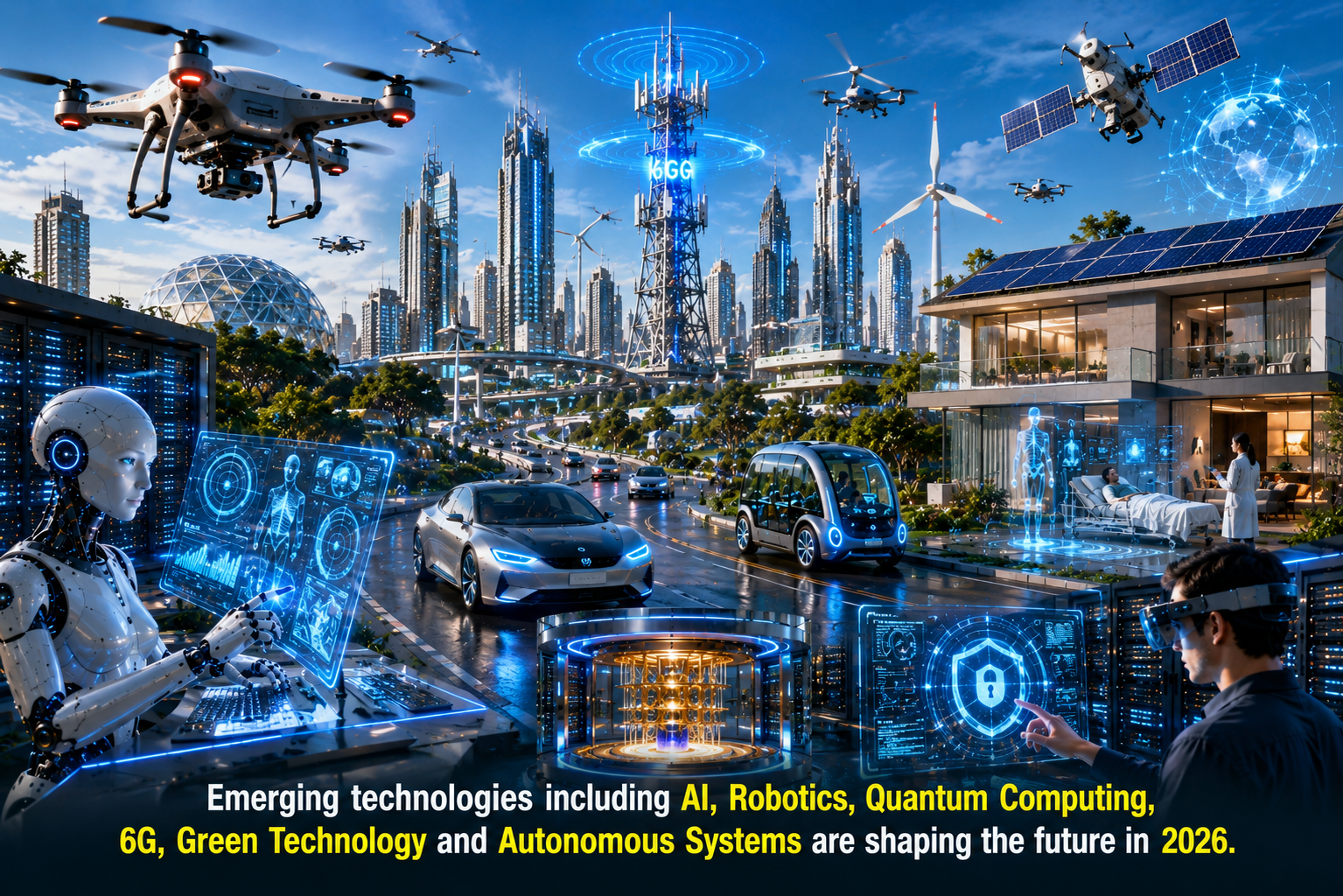
Technology is evolving at an unprecedented pace and 2026 is shaping up to be a defining year for digital innovation. Artificial intelligence, robotics, cybersecurity, quantum computing, next-generation connectivity, and sustainable technology are moving from emerging concepts toward practical applications across industries.
Businesses, governments, educational institutions, healthcare providers, and consumers are increasingly adopting intelligent technologies to improve productivity, security, communication, transportation, healthcare and everyday life.
For developers, IT professionals, entrepreneurs, students, and technology enthusiasts, understanding these trends is more than simply keeping up with the latest gadgets. It provides valuable insight into the skills, investments, opportunities and challenges that could shape the digital economy.
In this guide, Toplinks Techs explores the top 10 technology trends shaping 2026, including AI agents, robotics, quantum computing, AI-powered cybersecurity, 6G, green technology, extended reality, edge computing, healthcare technology and autonomous transportation.
Table of Contents
1. Artificial Intelligence Agents Become Everyday Assistants
2. Robotics Enter Mainstream Industries
3. Quantum Computing Moves Toward Commercial Reality
4. Cybersecurity Powered by Artificial Intelligence
5. 6G and Next-Generation Connectivity
6. Sustainable Green Technology
9. Healthcare Technology Revolution
11. Advantages of These Emerging Technology Trends
Artificial Intelligence Agents Become Everyday Assistants
Artificial intelligence is one of the biggest technology trends of 2026, but the focus is shifting beyond traditional chatbots toward AI agents capable of completing tasks with limited human intervention.
AI agents can potentially organize information, analyze data, automate workflows, assist with software development, manage customer service processes, schedule activities and support business decision-making.
Instead of simply responding to a question, an AI agent can be designed to understand a goal, break it into multiple tasks, use connected tools and provide an outcome.
Businesses are increasingly interested in agentic AI because it can help employees reduce repetitive workloads while concentrating on more strategic responsibilities.
For individuals, AI assistants could become more deeply integrated into smartphones, computers, productivity platforms, education and online services.
Read the full topic:
Suggested permalink: /ai-agents-everyday-assistants-2026/
Robotics Enter Mainstream Industries
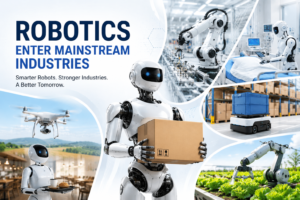
Robotics is moving beyond traditional manufacturing environments. In 2026, robots are increasingly being developed for logistics, healthcare, agriculture, retail, warehouses, construction, hospitality and other industries.
Advances in artificial intelligence, computer vision, sensors, batteries, and machine learning are helping robots operate more effectively in environments that previously required extensive human control.
Modern robots can assist with repetitive industrial tasks, warehouse operations, inspections, deliveries and specialized healthcare applications.
Humanoid robotics is also receiving significant attention as developers attempt to create machines capable of interacting with environments designed for humans.
Although widespread adoption will depend on affordability, reliability, safety and regulation, robotics is expected to remain an important area of technological development.
Read the full topic:
Suggested permalink: /robotics-mainstream-industries-2026/
3. Quantum Computing Moves Toward Commercial Reality
Quantum computing represents a fundamentally different approach to computation. Unlike conventional computers that use binary bits, quantum computers use quantum systems to process information in specialized ways.
The technology remains challenging, but progress in quantum hardware, error correction, algorithms, and research is bringing practical applications closer.
Quantum computing could eventually contribute to areas such as drug discovery, materials science, optimization, financial modeling, logistics and complex scientific simulations.
However, it is important to distinguish current research from widespread commercial deployment. Quantum computing is still an emerging field and significant technical challenges remain.
For technology professionals, 2026 is nevertheless an important period to understand the fundamentals of quantum computing and its potential long-term impact.
Read the full topic:
Suggested permalink: /quantum-computing-commercial-reality-2026/
4. Cybersecurity Powered by Artificial Intelligence
As cyberattacks become increasingly sophisticated, cybersecurity is becoming one of the most important areas of technology.
Artificial intelligence is being used to help security teams identify suspicious activity, analyze large volumes of security data, detect anomalies, prioritize threats, and respond to incidents more quickly.
At the same time, cybercriminals can also use AI to create more convincing scams, automate attacks, generate malicious content and improve social engineering techniques.
This creates a continuous technology race between attackers and defenders.
Organizations in 2026 are therefore expected to place greater emphasis on AI-assisted security, identity protection, zero-trust strategies, employee awareness, data protection and continuous monitoring.
Read the full topic here: AI Powered Cybersecurity 2026
5. 6G and Next-Generation Connectivity
While 5G continues to expand globally, researchers and telecommunications companies are already working toward the next generation of wireless communication.
6G is expected to target extremely high data speeds, lower latency, improved connectivity and greater integration between communication networks, artificial intelligence, sensing technologies and connected devices.
The technology is still under development, meaning widespread consumer 6G deployment should not be confused with current 5G services.
Nevertheless, early research could influence future smart cities, autonomous systems, immersive digital experiences, industrial automation and large-scale Internet of Things applications.
For consumers, the long-term goal is a more intelligent and highly connected digital environment.
Read the full topic here: 6G Next Generation Connectivity
6. Sustainable Green Technology
Environmental sustainability is becoming increasingly important as global technology consumption grows.
Data centers, artificial intelligence systems, electronic devices, transportation networks, and industrial infrastructure all require significant amounts of energy and resources.
Green technology aims to address these challenges through renewable energy, energy-efficient computing, sustainable materials, battery innovation, smart grids, electric transportation and improved recycling systems.
Artificial intelligence can also support sustainability by optimizing energy consumption, predicting equipment failures, improving logistics and helping organizations understand resource usage.
In 2026, sustainable technology is not simply an environmental issue. It is becoming an important component of long-term business strategy and infrastructure planning.
Read the full topic here: Sustainable Green Technology
7. Extended Reality (XR)
Extended Reality, commonly referred to as XR, combines technologies such as virtual reality (VR), augmented reality (AR), and mixed reality (MR).
XR is increasingly being explored for education, gaming, healthcare, employee training, industrial design, engineering, retail, entertainment and remote collaboration.
Modern mixed-reality devices can blend digital objects with the physical environment, creating new ways for users to interact with information.
For example, an engineer could visualize a digital model of equipment while working on a physical machine, while students could explore interactive educational environments.
As hardware becomes more powerful and comfortable, XR could become increasingly useful beyond entertainment.
Read the full topic here: Extended Reality (XR)
8. Edge Computing Expansion
Traditional cloud computing relies heavily on centralized data centers. Edge computing moves some processing closer to where data is generated.
This is particularly important for applications that require rapid responses, including industrial IoT, smart cities, autonomous machines, healthcare monitoring, security systems and connected vehicles.
By processing data closer to the source, edge computing can reduce latency and decrease the amount of information that must continuously travel to centralized servers.
The continued growth of IoT devices and AI applications is expected to increase demand for edge computing infrastructure.
Cloud and edge computing are therefore likely to operate together, with organizations using each approach according to the requirements of individual applications.
Read the full topic here: Edge Computing Expansion Across Industries
9. Healthcare Technology Revolution
Technology continues to transform healthcare through digital health platforms, wearable devices, telemedicine, AI-assisted diagnostics, remote patient monitoring and personalized healthcare solutions.
Artificial intelligence can help healthcare professionals analyze medical information and identify patterns that may support clinical decision-making.
Wearable technologies can also collect health-related data and provide users with information about their activity, sleep, heart rate and other measurements.
Telemedicine is expanding access to healthcare services by allowing patients to communicate with healthcare professionals remotely.
However, healthcare technology must be implemented carefully because privacy, cybersecurity, accuracy, regulation and human oversight remain critical.
Read the full topic here: Healthcare Technology Revolution 2026
10. Autonomous Transportation
Autonomous transportation is another technology area attracting significant attention in 2026.
Self-driving technologies combine cameras, radar, sensors, artificial intelligence, mapping systems and advanced computing to help vehicles understand their surroundings and make driving-related decisions.
Autonomous technology is also being explored in logistics, delivery services, public transportation, agriculture, mining and industrial environments.
The technology has the potential to improve transportation efficiency and reduce certain types of human error, but challenges involving safety, regulation, infrastructure, cost, cybersecurity and public acceptance remain.
Rather than becoming universally autonomous overnight, transportation is likely to evolve gradually as different levels of automation become available for specific applications.
Read the full topic here: Autonomous Transportation 2026
Advantages of These Emerging Technology Trends
The technologies shaping 2026 could provide significant benefits to individuals, businesses, government, and society.
1. Increased Productivity
AI agents, automation, robotics and intelligent software can reduce repetitive tasks and help organizations accomplish work more efficiently.
2. Improved Decision-Making
AI and advanced analytics can process large volumes of information, helping organizations identify patterns and make more informed decisions.
3. Better Connectivity
Next-generation networks, edge computing, and IoT technologies can create faster and more responsive digital experiences.
4. Enhanced Healthcare
Digital healthcare tools can support remote monitoring, telemedicine, medical research and more personalized services.
5. Greater Sustainability
Green technologies can help reduce energy consumption, optimize resources, improve transportation and support renewable energy adoption.
6. New Career Opportunities
Emerging technologies are creating demand for professionals in AI, cybersecurity, software development, cloud computing, robotics, data science, quantum computing and other technical fields.
7. Improved Automation
Robotics and autonomous systems can perform dangerous, repetitive, or highly specialized tasks, potentially improving workplace efficiency and safety.
(FAQs)
What is the biggest technology trend in 2026?
Artificial intelligence remains one of the most influential technology trends in 2026. AI agents, generative AI, AI-powered cybersecurity, automation, and intelligent software are affecting numerous industries.
Will AI replace human workers in 2026?
AI is expected to automate some tasks and change the way many jobs are performed, but it does not mean that all human workers will be replaced. Human judgment, creativity, communication, leadership, and specialized expertise remain important.
Is 6G available to consumers in 2026?
6G is still primarily an area of research, development, standardization, and testing. Consumers should not assume that widespread commercial 6G networks are already available simply because companies are actively developing the technology.
What industries will benefit most from robotics?
Manufacturing, logistics, healthcare, agriculture, construction, warehousing, mining, and other industries involving repetitive or hazardous tasks are among the sectors that can benefit from robotics.
Why is cybersecurity important in 2026?
As businesses and individuals become increasingly dependent on digital systems, cyber threats can have serious financial, operational, and privacy consequences. AI-assisted cybersecurity can help organizations detect and respond to threats more effectively.
What skills should students learn for the future of technology?
Students and aspiring technology professionals can benefit from learning programming, artificial intelligence, cybersecurity, cloud computing, data analysis, networking, software development, problem-solving, and digital literacy.
Will autonomous vehicles become common in 2026?
Autonomous transportation is developing rapidly, but adoption varies by country, company, vehicle type, regulation, and operating environment. Widespread fully autonomous transportation should be viewed as a gradual development rather than an immediate global transition.
Why is green technology important?
Green technology can help organizations and communities reduce energy consumption, improve resource efficiency, lower environmental impact and support more sustainable infrastructure.
Conclusion
The technology landscape of 2026 is being shaped by a combination of artificial intelligence, automation, connectivity, cybersecurity, sustainability, advanced computing, and intelligent machines.
From AI agents and robotics to quantum computing, 6G, healthcare technology, and autonomous transportation, these developments have the potential to influence how people work, communicate, travel, learn, access healthcare and interact with digital services.
However, technological progress also comes with challenges. Privacy, cybersecurity, misinformation, ethical AI, job transformation, environmental impact, regulation and digital inequality will require continued attention.
For businesses and professionals, the best approach is not simply to follow every new technology but to understand which innovations are relevant to their goals.
For students and technology enthusiasts, learning the fundamentals behind these trends can provide a strong foundation for future opportunities.
2026 is not just another year of technological advancement—it is another major step toward a more intelligent, connected, automated and digitally driven world.
Stay informed, keep learning and continue exploring the technologies that are shaping tomorrow.
About the Author
Olu-Tope Abraham is an IT Support Specialist, Web Developer, Software Developer, UI/UX enthusiast and digital technology professional with an interest in emerging technologies, web development, cybersecurity, artificial intelligence, consumer technology and digital innovation.
Through Toplinks Techs, he shares practical technology insights, tutorials, guides, industry trends and informative resources designed to help readers understand and make better use of modern technology.
Toplinks Techs — Innovate. Explore. Elevate. Tech That Inspires Progress.